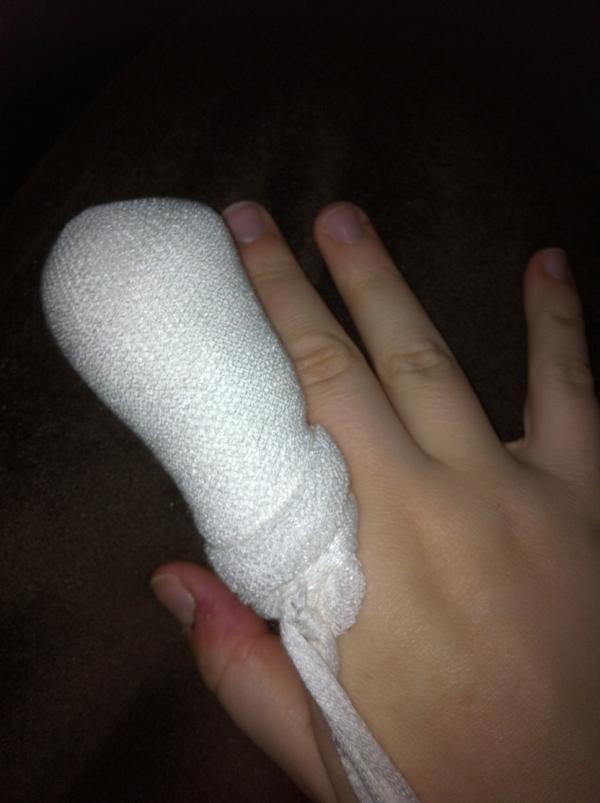
I was seated on the plane with a young graduate student from Tennessee who told me of being raised by her single military mom. She made the comment that when 9/11 struck she was only a child of 11. The events were so far away, young Belinda thought it could never affect her life. It wasn't long before her mother was deployed leaving her in the care of her grandmother and, in the process, changing her life forever.
As I found my bus stop at Miami international and settled in for an hour wait, a young Bolivian man happened by to catch the same bus. He told me he was really tired after sleeping overnight in the airport when he missed the bus the night prior. Until 2009, his family had lived in La Paz as his step father was working for the American embassy. This apparently provided a streamlined move to the US and he seems to love his life here. His English was flawless. I had to laugh when he told me about his step father and mother asking him what he thought of having a baby brother or sister. "Can't you just get a dog?".
After boarding the bus, I detected a distinct accent from three ladies in the seats ahead of me. As it turns out, they were from Argentina. I very excitedly asked them about Buenos Aires as it is finding it's way on my new bucket list. They were not fans of the city nor the president who is the first elected female leader in that country, citing runaway inflation, crime and smoke spewing buses.
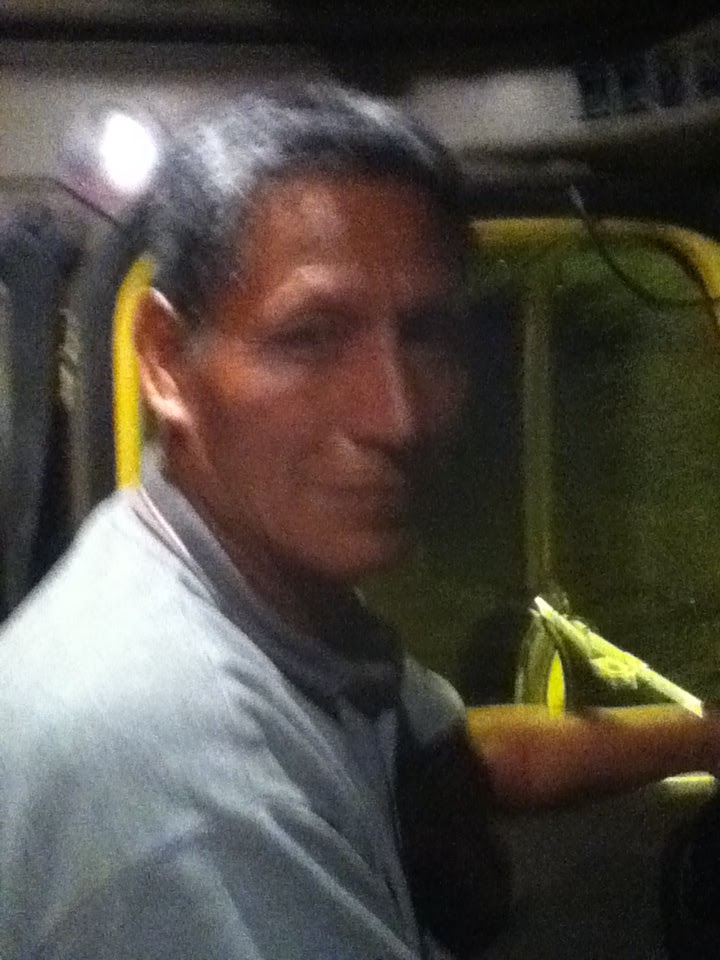
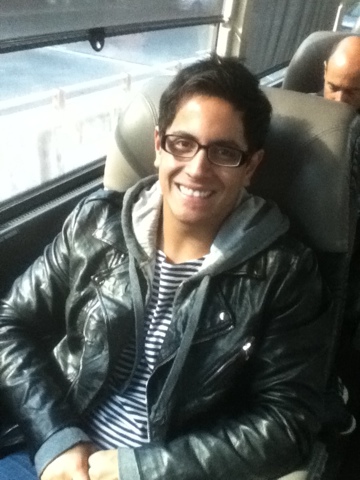
Everyone has a story. Airport stories are more interesting than most. Carlos is pictured below.
A single woman's life in later years can still be a work in progress....
Tuesday, February 5, 2013
Sunday, January 27, 2013
Hitchhiking in Ecuador..........makes me smile!
I had a lovely evening in Cuenca. I first met with two couples at 6:30 p.m. at a restaurant called El Tiestos which was eight blocks from a singles event I was scheduled to attend at 7:00 p.m. The conversation and people were so delightful I did not leave until almost 8:00 p.m. The singles event was at Cafe Eucalyptus where I met even more interesting people so I left there around 9:15 p.m. in a cab to the bus station feeling elated over new acquaintances. This being a weekend, I boarded the bus to Macas as buses which terminate in Paute do not run that late. The bus to Macas skirts through Paute and I have done that several times in the past.
The trip from Cuenca to Paute takes around an hour and fifteen minutes. I read for around twenty minutes and felt a little tired so I leaned the seat back ignoring the protesting thumps from behind. I was tired, damn it, and my seat mate was doing the same and I'm old so I felt entitled. I did feel quite drowsy so I dozed off in what I thought was a bit of twilight sleep.
At one point, I awoke to feel the bus stopped and noticed the bus driver slipping off to an open tienda to buy snacks and drinks and wondered what town we were in. As we started again, I noticed some familiar architecture of apartments that rounded the corner and felt we were getting close. Then, I saw lights off in a distance that seemed much too far downhill. I had never noticed anything like that on any previous trip so I got up to ask the driver how far it was to Paute. They told me we had passed Paute around eight kilometers back. PANIC! They instructed me to come forward and sit on a seat in the front.
We drove an incredibly long time through darkness. They assured me there would be a bus coming back to Cuenca and stopped in a small town called Sevilla de Oro. They showed me where the bus bench was and I was to wait there for only about thirty minutes. I should have no problems. It was 11:50 p.m.
| Pictures or it didn't happen! |
| Lonely dark streets! |
| My park bench of over an hour |
| My hero! |
No, if you will excuse me, I need to take a nap!
Tuesday, January 1, 2013
New Years Eve in Paute.....makes me smile...and sleepy!!
| Jumping the fire for good luck! |
I'll be honest. I'm tired. I had very little to drink and that was confined to a couple of shots passed out along our walks through town. I know how cane alcohol tastes now! The evening started out with a fantastic dinner at Jani's house, including turkey and gravy, sweet potatoes as well as mashed, pea salad, and assorted vegetables. As if that was not enough, out came the apple pie and ice cream. There was not enough room for very much alcohol after that was over.
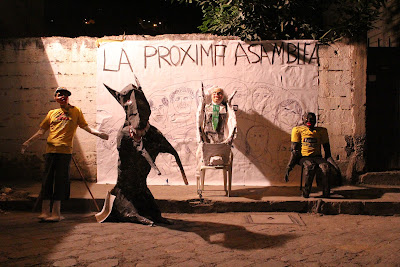
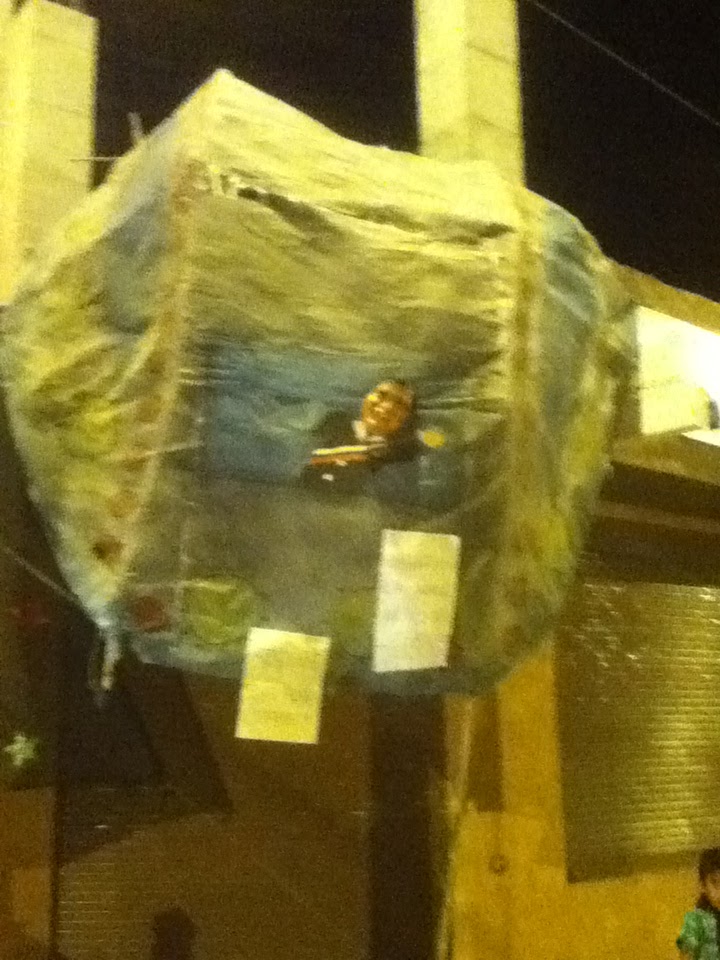
I'd just like to let the pictures tell the stories. James, Susan, Jani and I had a fantastic time. What a zest for life the Ecuadorians have!! Have a wonderful New Year to everyone!! Keep focused and stay positive! Life is NOT a dress rehearsal!!
![]() |
| Boy and sister showing off their guy. |
![]() |
| Soooo, wazzup? |
| This was either a policeman or military. |
| If I knew more about Ecuador, I could tell you who this is. |
| The motorcycle gang! |
| Need a boob job? I can get you one. Cheap. |
| It looked like a telling of the indigenous history of Ecuador. |
| This is the Ecuadorian assembly. Notice the donkey? Some months ago, there was a group trying to get him on the ballot. |
| There was some heavy rock coming from here! |
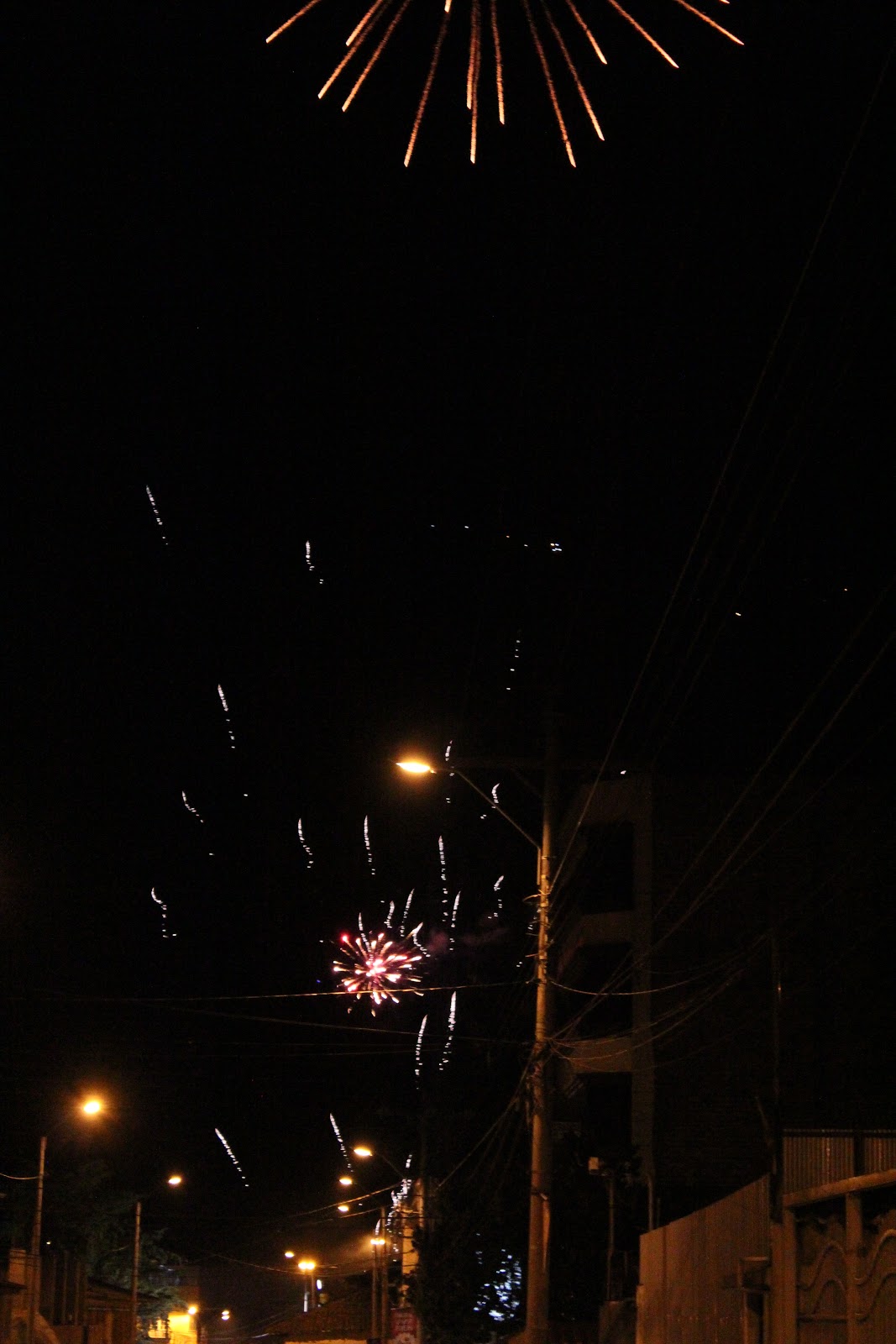
| There were lots of fireworks!! |
| Cute little boy. Unfortunately a little later, when his grandfather was helping him across the fire, both went down in a face plant on the concrete. I certainly hope all is well. |
| Firecrackers tossed at the church. |
| The gangs all here! Including somebody picked up along the way! |
| Goodbye to my "esposo" of a few days and all my negative feelings of 2012 |
Wednesday, June 6, 2012
A different world.........makes me smile
![]() |
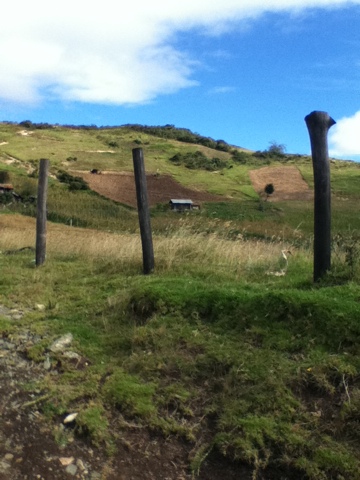
| If you look very closely, you will see the oxen between the first and second pole near the top |
I have a secret mission and it took me on an unforgettable journey. I'm basically a suburban city girl so there are many things I have never seen in rural life. When I was a child I was privileged enough to be able to spend weeks at my grandparents dairy farm but even then, in the 50s, they had a tractor.
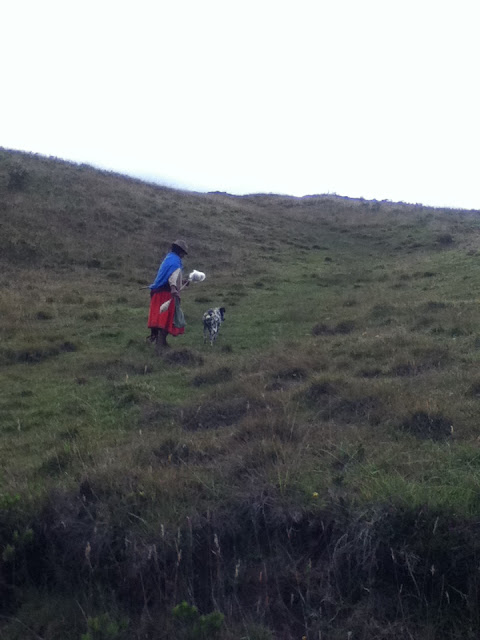
| Working her thread through the fields. |
I have had two amazing
trips into the mountaintops
of Paute. I have seen men
plowing their fields with
oxen. There were children
herding a flock of sheep and
freshly shorn wool hanging
to dry. There was a woman
walking through the fields
working her wool into thread.
I saw wild grouse.
![]() |
| Look at the cuties I found around the corner! |
![]() |
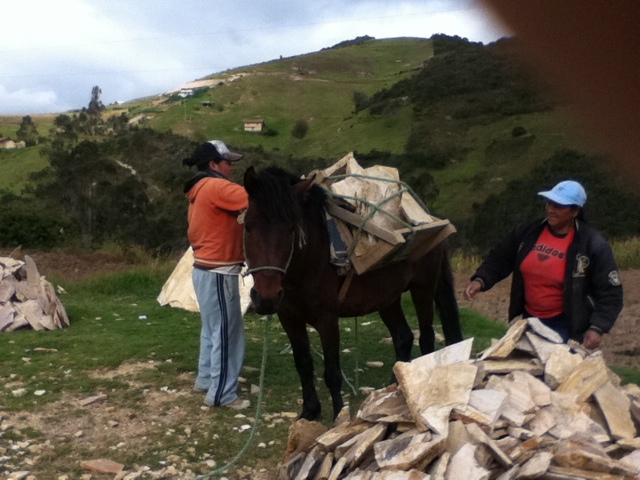
| This horse carried a fair burden bringing rock up from the mines. |
There is a rock mine in the top of the mountains where beautiful slate type stones are hoisted by horseback and sold for use as walkways and for gorgeous house sidings. I managed to get one piece big enough to take to a carpenter to make a table. The natural coloring tells stories of many milleniums of rising and receding waters.
![]() |
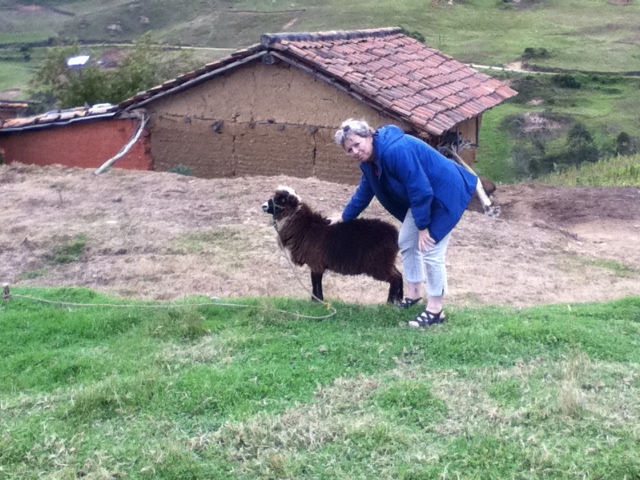
| Two black sheep getting to know one another. |
I met a soulmate of sorts in a black sheep on one lady's farm. That was one Ecuadorian with which I had no problem communicating. All black sheep have a lot in common.
![]() |
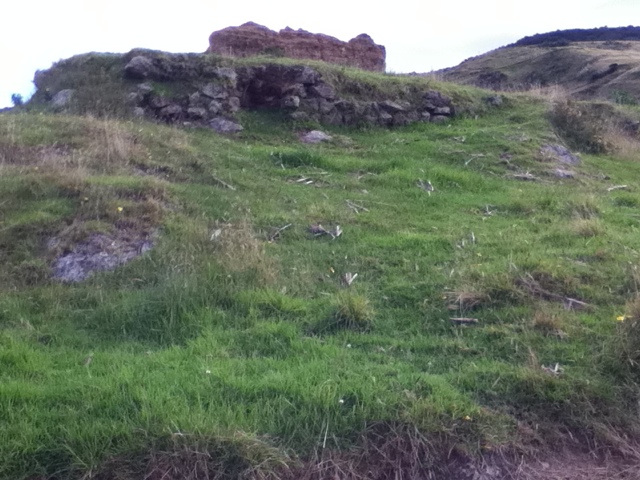
| Ruins of a 400 year old house. |
I was amazed that people live in houses with
baked mud thatched walls. Not far from that
house were 400 year old ruins of another mud
thatched house from the forefathers of the very
people living nearby.
![]() |
| A mud thatched house where someone lives today. Notice the pig in the front yard. Future meal. |
If you are in the Cuenca area, make a day trip to Paute on a Sunday. See the chaotic Market in the morning and hire Rodrigo in the afternoon to take you up to a world few Westerners have seen. That will be the day you see the true Ecuador.
Friday, May 11, 2012
Tea and sympathy.......makes me smile
I'm making tea today. You can drink it at your own risk and get my sympathy. But the real target of this tea are the tiny little creatures that are eating the garden.
Around 20 years ago, I had a very good-looking cowboy type boyfriend. He lived on some small acreage and invited me and my daughter, who was around 12 at the time, to come out for the day. He let her shoot his gun and gave her a rabbit with a cage when we were leaving. A few mornings later, the rabbit was dead. I asked my daughter what happened and she said she didn't know. All she knew was she had gone to the backyard to gather some grass for Thumper the night before and he was dead in the morning. I remembered the chemicals I had sprayed on the grass and plants the afternoon before for bugs and suddenly I realized the murderous agent. If there was anything funny about that episode, it was when I called the boyfriend and simply told him the rabbit died. After an uncomfortable silence, he blurted out "Oh my God! I've been told that three times in my life! I wasn't counting on hearing it again!". I assured him I was NOT with child and that it was, indeed, the bunny facing a ceremonious burial in my backyard.
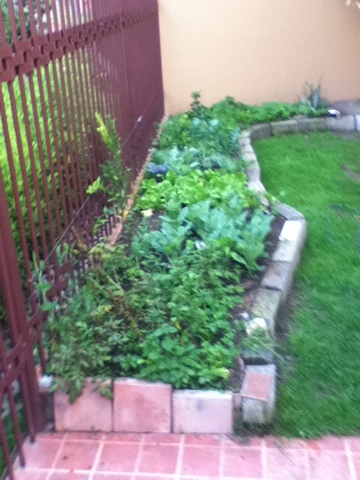
When I was asked to housesit Jani's house, I was excited about the prospect of gardening in her backyard as she was encouraging it. As anyone who has at least a passing thought of me knows, I have two beloved 8 pound pooches named Bear and Amber. There would be no poison here as was done to the poor unsuspecting rabbit from long ago. If anything was going to discourage the critters who seem to like the very same vegetables as I do, it would have to be something that was unharmful to the dogs. Something organic.
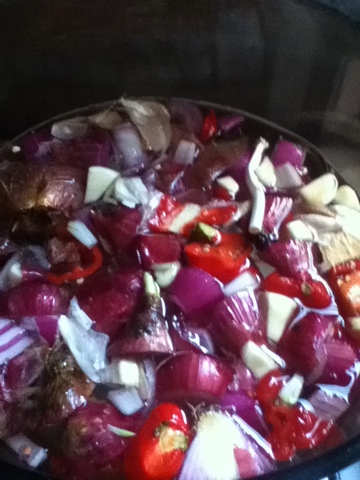
A young European man I met in a garden store on the Calle Largo, a street in Cuenca, advised me to use red hot peppers, red onions and garlic in a tea to spray if I found any bugs. A few weeks ago, I hosted a couple who verified the tea method and verified I had small mites and bugs as well. It was teatime.
I have no idea of the effectiveness of this tea. My guests informed me that the broccoli was in dire need since it was about to flower. Bubble, bubble toil and trouble!!
There is not a real recipe. It is a tea with all the liquid drained from the actual vegetables after it has been allowed to steep and cool. There is no need to clean and peel although I did slice everything to allow the hot seeds in the pepper, the aroma of the red onions, and the natural smell of the garlic to do their job while boiling.
A composting pail in the farthest part of your yard (flies) is very good for your garden as long as no meat or animal products are included. Animal products won't kill your garden but the rodents it attracts will. An exception would be eggshells as long as the egg has been cleaned out and dried from the inside. An afternoon in the very direct Andean sun does a very good job.
Around 20 years ago, I had a very good-looking cowboy type boyfriend. He lived on some small acreage and invited me and my daughter, who was around 12 at the time, to come out for the day. He let her shoot his gun and gave her a rabbit with a cage when we were leaving. A few mornings later, the rabbit was dead. I asked my daughter what happened and she said she didn't know. All she knew was she had gone to the backyard to gather some grass for Thumper the night before and he was dead in the morning. I remembered the chemicals I had sprayed on the grass and plants the afternoon before for bugs and suddenly I realized the murderous agent. If there was anything funny about that episode, it was when I called the boyfriend and simply told him the rabbit died. After an uncomfortable silence, he blurted out "Oh my God! I've been told that three times in my life! I wasn't counting on hearing it again!". I assured him I was NOT with child and that it was, indeed, the bunny facing a ceremonious burial in my backyard.
When I was asked to housesit Jani's house, I was excited about the prospect of gardening in her backyard as she was encouraging it. As anyone who has at least a passing thought of me knows, I have two beloved 8 pound pooches named Bear and Amber. There would be no poison here as was done to the poor unsuspecting rabbit from long ago. If anything was going to discourage the critters who seem to like the very same vegetables as I do, it would have to be something that was unharmful to the dogs. Something organic.
A young European man I met in a garden store on the Calle Largo, a street in Cuenca, advised me to use red hot peppers, red onions and garlic in a tea to spray if I found any bugs. A few weeks ago, I hosted a couple who verified the tea method and verified I had small mites and bugs as well. It was teatime.
I have no idea of the effectiveness of this tea. My guests informed me that the broccoli was in dire need since it was about to flower. Bubble, bubble toil and trouble!!
There is not a real recipe. It is a tea with all the liquid drained from the actual vegetables after it has been allowed to steep and cool. There is no need to clean and peel although I did slice everything to allow the hot seeds in the pepper, the aroma of the red onions, and the natural smell of the garlic to do their job while boiling.
A composting pail in the farthest part of your yard (flies) is very good for your garden as long as no meat or animal products are included. Animal products won't kill your garden but the rodents it attracts will. An exception would be eggshells as long as the egg has been cleaned out and dried from the inside. An afternoon in the very direct Andean sun does a very good job.
Monday, April 30, 2012
Venga! Venga! Venga!........makes me smile!
Learning about languages makes me smile! In Spanish, "Venga Venga! Venga!" is much more lyrical than "Come! Come! Come! Of course, that certainly depends upon to whom it is directed.
The first time I heard someone say this was last week when I was at the vet's office leaving the little monsters before my quick trip to Loja and Vilcabamba. Bear had slipped out of her hands, trying to follow me. Venga! Venga! Venga! I had to figure out how to spell that! I just didn't know how to ask. It did remind me of the famous scene in Shakespeare's Julius Caesar when the title character exclaimed "Veni! Vidi! Vici!", which is Italian for " I came! I saw! I conquered".
On my trip back to Paute, the bus stopped for a group of people and the bus driver said "Venga! Venga! Venga! This has become my new catch phrase.
In the Spanish language, all vowels are pronounced and they only have one sound each. The "a" is as in the sound the doctor tells you to make when he tells you to open wide. "Ahhhhh". The "e" sounds like the "a" in cake. The "i" actually sounds like an "e" as in the english word keep. The "o" has the long and definite sound as in oh. Finally, the "u" sounds like the double o sound in stoop. I have a dog named Bear. When my Spanish speaking friends call his name, it sounds just like a southerner in the U.S. ordering their favorite alcoholic beverage at the local bar.
When I first moved to Ecuador, I was intrigued by the word zanahoria. First of all, I could never remember it. It is the Spanish word for carrot. Second of all, it didn't seem Spanish. It didn't flow well to me. When I asked my Ecuadorian friend in Vilcabamba, Lucia, she gently told her gringa friend it was not a Spanish word at all. When the Muslim crusades came to Spain, part of their language was left. Zanahoria is an Arab word.
As with English, which was shaped through the Roman, Germanic and French conquests of the British Isles, Spanish also has the elements of war and conquest. Just the very presence of Spanish in South America is a result of the invasion of Spain more than 500 years ago. The Spanish in Ecuador is a little different from the Castilian Spanish spoken in Europe because some "loan" words come from the indigent Quechua language. In fact, there are 8 to 10 million Quechua speakers in South America. It even has the status of being an official language in both Bolivia and Peru along with Spanish.
History is a passion of mine. The study of the history of languages is called Etymology. Hatians speak a version of French. Vietnamese have some French mixed in their native tongue. Brazilians speak primarily Portuguese. English and a version of Dutch called Afrikaans is spoken in South Africa. There are scatterings of French, English, Portuguese, Spanish and Dutch throughout Africa even though there are studies showing anywhere between 1500 and 2000 native tongues in use on that same continent today. The official language of the Congo us French and of Angola, Portuguese. In Asia, Malaysians speak more English in their own country than they do of their traditional Malay.
Yes, learning about languages is fun with a dash of the dark side of war and conquest. I read a book recently that my daughter recommended by Jared Diamond called Guns, Germs, and Steel. It is an amazing history of why some societies succeeded over others and consequently changed the verbal landscape of the conquered lands forever. I recommend it highly.
There are no pictures to compliment this post because pictures of people talking just wouldn't transfer well. I decided to include some fun photographs taken around Paute and Cuenca.
In the meantime, Venga! Venga! Venga! And that is directed to a certain sailing enthusiast in Canada.
The first time I heard someone say this was last week when I was at the vet's office leaving the little monsters before my quick trip to Loja and Vilcabamba. Bear had slipped out of her hands, trying to follow me. Venga! Venga! Venga! I had to figure out how to spell that! I just didn't know how to ask. It did remind me of the famous scene in Shakespeare's Julius Caesar when the title character exclaimed "Veni! Vidi! Vici!", which is Italian for " I came! I saw! I conquered".
On my trip back to Paute, the bus stopped for a group of people and the bus driver said "Venga! Venga! Venga! This has become my new catch phrase.
In the Spanish language, all vowels are pronounced and they only have one sound each. The "a" is as in the sound the doctor tells you to make when he tells you to open wide. "Ahhhhh". The "e" sounds like the "a" in cake. The "i" actually sounds like an "e" as in the english word keep. The "o" has the long and definite sound as in oh. Finally, the "u" sounds like the double o sound in stoop. I have a dog named Bear. When my Spanish speaking friends call his name, it sounds just like a southerner in the U.S. ordering their favorite alcoholic beverage at the local bar.
When I first moved to Ecuador, I was intrigued by the word zanahoria. First of all, I could never remember it. It is the Spanish word for carrot. Second of all, it didn't seem Spanish. It didn't flow well to me. When I asked my Ecuadorian friend in Vilcabamba, Lucia, she gently told her gringa friend it was not a Spanish word at all. When the Muslim crusades came to Spain, part of their language was left. Zanahoria is an Arab word.
As with English, which was shaped through the Roman, Germanic and French conquests of the British Isles, Spanish also has the elements of war and conquest. Just the very presence of Spanish in South America is a result of the invasion of Spain more than 500 years ago. The Spanish in Ecuador is a little different from the Castilian Spanish spoken in Europe because some "loan" words come from the indigent Quechua language. In fact, there are 8 to 10 million Quechua speakers in South America. It even has the status of being an official language in both Bolivia and Peru along with Spanish.
History is a passion of mine. The study of the history of languages is called Etymology. Hatians speak a version of French. Vietnamese have some French mixed in their native tongue. Brazilians speak primarily Portuguese. English and a version of Dutch called Afrikaans is spoken in South Africa. There are scatterings of French, English, Portuguese, Spanish and Dutch throughout Africa even though there are studies showing anywhere between 1500 and 2000 native tongues in use on that same continent today. The official language of the Congo us French and of Angola, Portuguese. In Asia, Malaysians speak more English in their own country than they do of their traditional Malay.
Yes, learning about languages is fun with a dash of the dark side of war and conquest. I read a book recently that my daughter recommended by Jared Diamond called Guns, Germs, and Steel. It is an amazing history of why some societies succeeded over others and consequently changed the verbal landscape of the conquered lands forever. I recommend it highly.
There are no pictures to compliment this post because pictures of people talking just wouldn't transfer well. I decided to include some fun photographs taken around Paute and Cuenca.
In the meantime, Venga! Venga! Venga! And that is directed to a certain sailing enthusiast in Canada.
![]() |
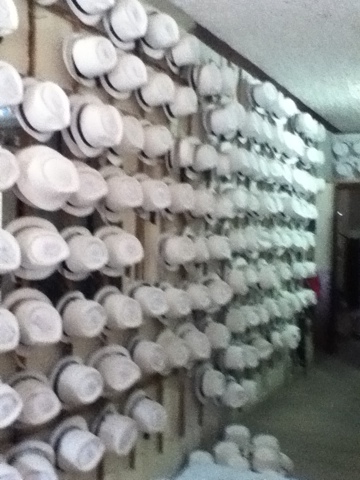
| There is a Panama Hat store in Paute. Panama hats were originally created in Ecuador. |
![]() |
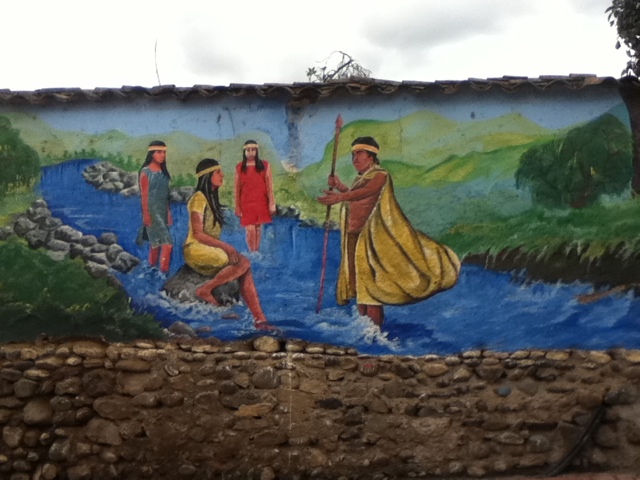
| Awesome graffiti art in Paute. - |
![]() |
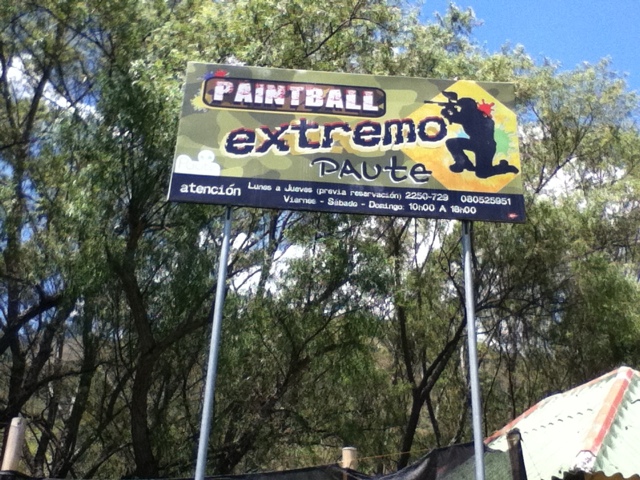
| Kids need to have fun!! This was the work of an American in Paute. |
![]() |
| This is so strange. Young girls wanted to have their pictures taken with me in China, too. |
![]() |
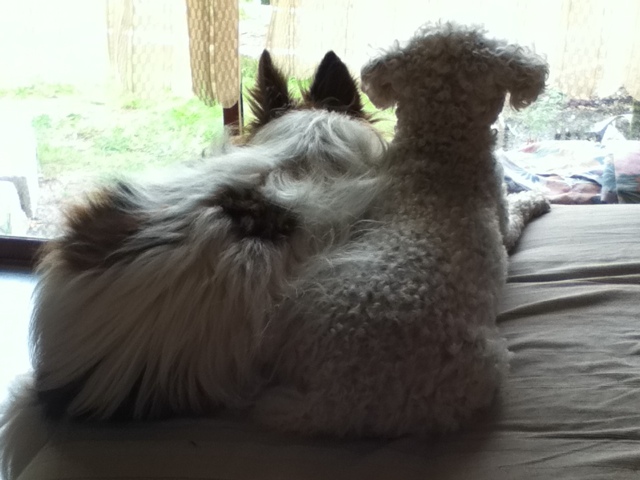
| Someone to watch over me! |
![]() |
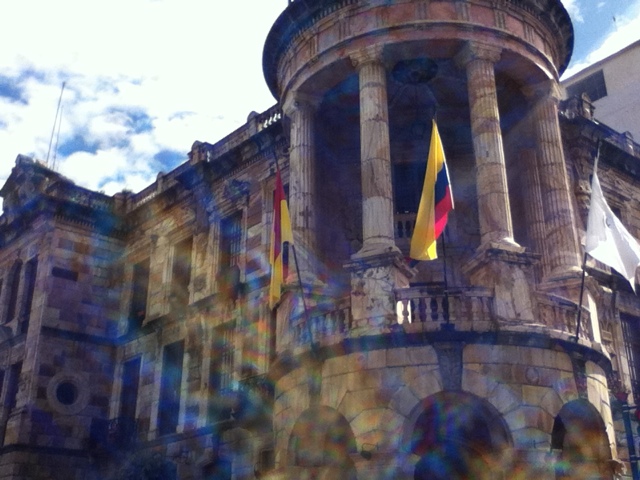
| Gorgeous art college in Cuenca. I thought it was a church! |
Tuesday, April 24, 2012
Using the public hospital in Cuenca......made my friend smile.
My friend, Diana, who lives in Cuenca, had an interesting experience last week with her teenager involving the public health services of Ecuador. I found her entire experience intriguing as Cuenca is a large city with the usual red tape when it comes to services. I am sure I would never have done as well as she!!
Last Week my teenager announced that his finger was swollen and green, so I looked at it. Okay, so that's gross. How long has it been like this? Oh, I don't know, a few days. Yikes!!
Here in Cuenca, Ecuador, we had been going to a private clinic near our home for our health care needs, but the cost was $18.42 per visit with no insurance. The doctors there are great, friendly, professional, and went to medical school in those fancy rich countries like Canada, the U.S., and various parts of Europe. Okay, so you're thinking, what's the problem with $18? Well, it might not sound like a lot, but when your monthly budget is only a few hundred dollars, it does start to add up. It adds up especially when you end up having to return several times.
So, it was time to check out the public clinics which are free to everyone. The first problem was that nobody could tell us where our public clinic was. Apparently everyone in the city is assigned a public clinic based on their address. We went to a different public cliinic and they told us we should just go to the public hospital.
The next problem was finding the public hospital. We were told it was the hospital of Vergel as well as its general vicinity. We took the bus to the right area and started looking for the "Hospital de Vergel" with no luck. At that point, we started asking people. Eventually we were directed to the correct building which had a long name, none of which included the word Vergel. It turns out that Vergel is the name of the part of the city where the hospital is located.
Once inside the building, we were overwhelmed by the sheer size and chaos of the place. Seriously, a person could do their running practice in this building on those really rainy days. If you ran down every hallway it would surely add up to a few miles. There were crowds of people everywhere waiting, waiting, for what we didn't know. We found an information desk and showed her the green finger. Ewww!! She explained the directions to get to Curacion. We took the necessary turns and found the right room. Unfortunately, the person there told us we would have to take the finger to the Emergency Room. We followed the directions she gave us (we thought) to a big open room with a crowd waiting and asked about getting the help we needed. The people there told us the finger issue was not serious enough to warrant a trip to the E.R. They told us we would need to go to our local public health clinic at Feria Libre, a huge open food market near our home.
At this point we were unsure how to proceed. I was discussing it with my son as we walked back toward the hospital entrance, noting that the people at the E.R. had told us to go to the local clinic. My son interrupted, "Um, mom, that was the Audiology Department." I turned around to look at the sign and, sure enough, it said "Audiologia".
We returned to the Information Desk to ask how to find the clinic. ¿Que pasa? We explained. She said there IS no public clinic at Feria Libre. Then she took pity on us. She abandoned her post to walk us all the way back to Curacion, where she exchanged a few words with the same woman who had sent us away the first time. Ninety seconds later the woman from Curacion was directing my son to come with her and for me to wait outside on the bench. I did not hear any screams, but when my son returned the finger was bandaged, presumably no longer green as all the green seemed to be in his face. When we discussed it later, he said he was sure that at the PRIVATE clinic they would have used an anesthetic.
He sat on the bench with me for a while until the nausea went away. During that time the woman from Curacion reappeared and told us we would have to go to the E.R. to get some medicine to prevent a re-infection. She walked us through various hallways to point us in the right direction to find the E.R. explaining that she could not write a prescription. Everywhere we went people seemed surprised to see the extranjeros (Foreigners) in the public hospital.
There was a small crowd at the E.R. and two little reception areas connected to the waiting room. We asked the person working at the first one what to do and she said we needed to talk to the person in the other room. That person was not there and it occured to us that maybe a lot of the people there were also waiting for this person to return. Apparently the locals were paying attention because when someone came out of the E.R. area, one of them told him the extranjeros needed help. That man then approached us and took us to an office inside where we spoke to a doctor who wanted to see the prescription which we did not have. She wanted to know the story of the finger after which she took us into a big E.R. room where people sat smiling with bloody bandages, amazed to see the extranjeros there. A doctor who was clearly busy was very pleasant in writing a prescriiption for us and directed us to fill it at a pharmacy. I really didn't know if we would have gotten the medication for free if we had looked poorer, but we were very happy to have the finger on the mend and left to find a pharmacy.
We were never once asked for any information on our finances or immigration status. Apparently their services are free for anyone who walks in. This is SO different from the health care system in the U. S.! We also have Canadian friends here whose doctor explained to them that medical professionals are required to work some number of hours each week at the public clinics or hospitals, indicating that the care is really just as good, albeit more chaotic, to get.
Upon reflection, we felt very well cared for at the public hospital, having had so many people go out of their way to help us. And it was yet another of many cultural experiences, something we are not likely to stop having anytime soon!
Last Week my teenager announced that his finger was swollen and green, so I looked at it. Okay, so that's gross. How long has it been like this? Oh, I don't know, a few days. Yikes!!
Here in Cuenca, Ecuador, we had been going to a private clinic near our home for our health care needs, but the cost was $18.42 per visit with no insurance. The doctors there are great, friendly, professional, and went to medical school in those fancy rich countries like Canada, the U.S., and various parts of Europe. Okay, so you're thinking, what's the problem with $18? Well, it might not sound like a lot, but when your monthly budget is only a few hundred dollars, it does start to add up. It adds up especially when you end up having to return several times.
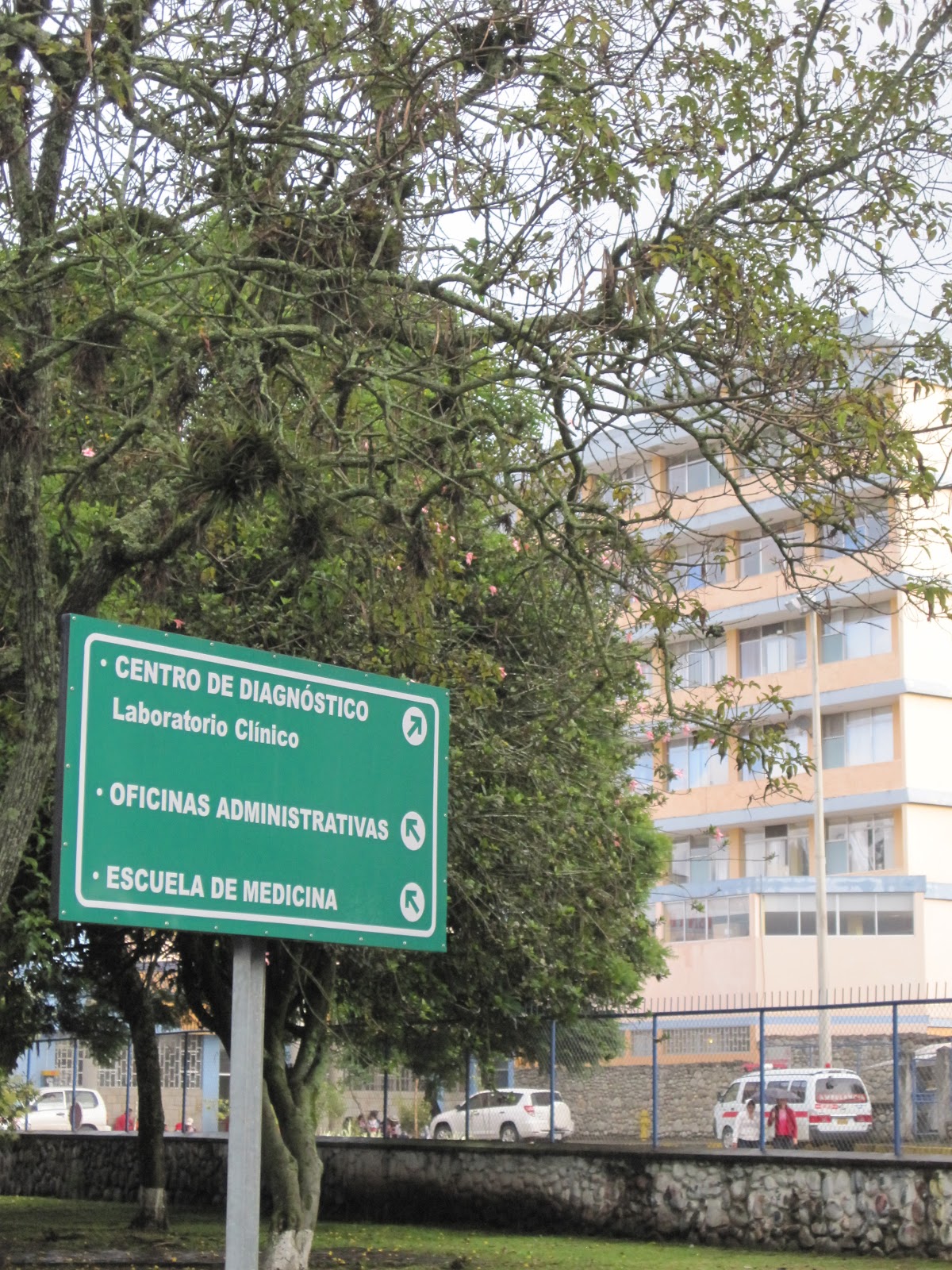
| Good directions! |
So, it was time to check out the public clinics which are free to everyone. The first problem was that nobody could tell us where our public clinic was. Apparently everyone in the city is assigned a public clinic based on their address. We went to a different public cliinic and they told us we should just go to the public hospital.
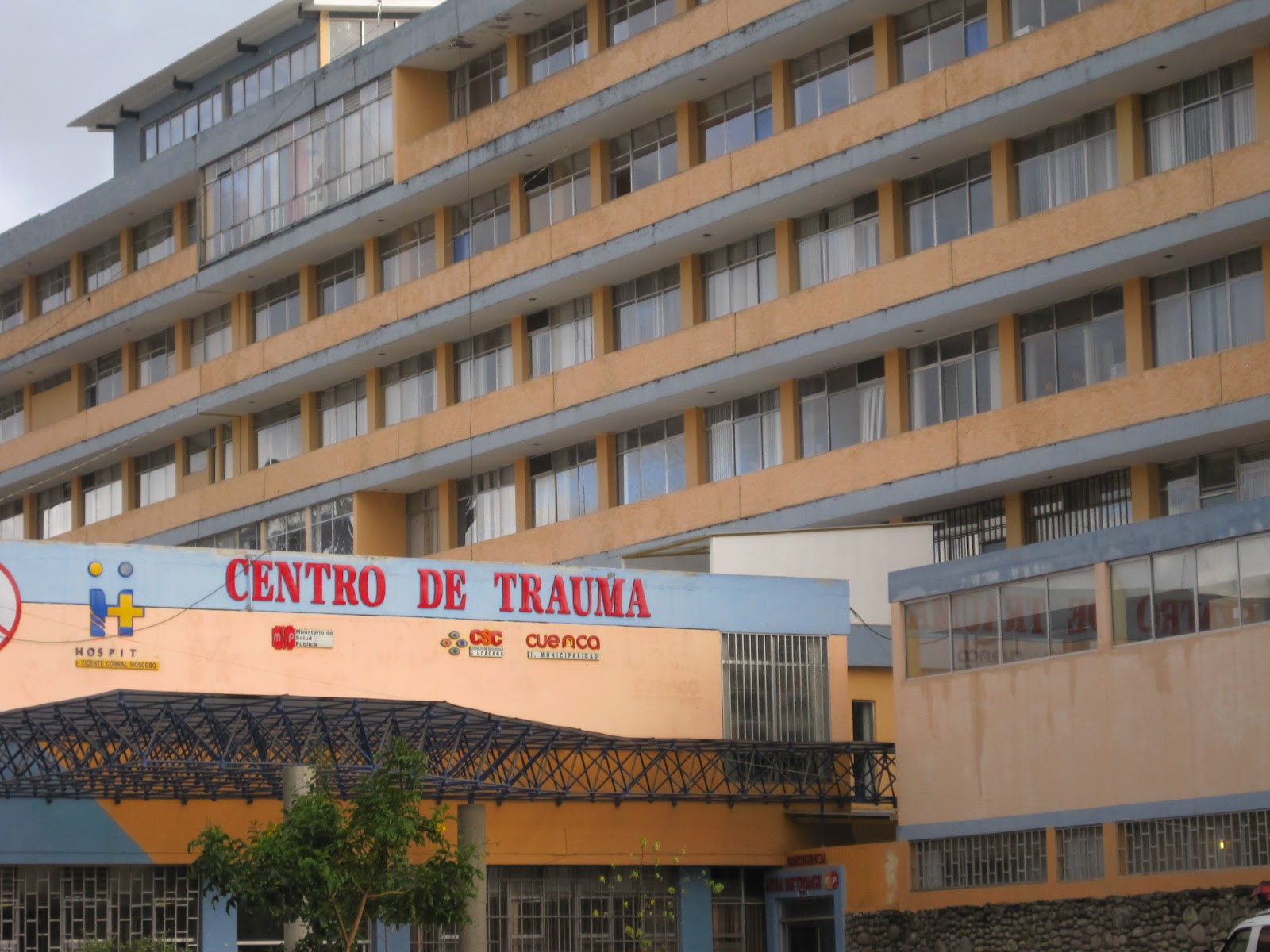
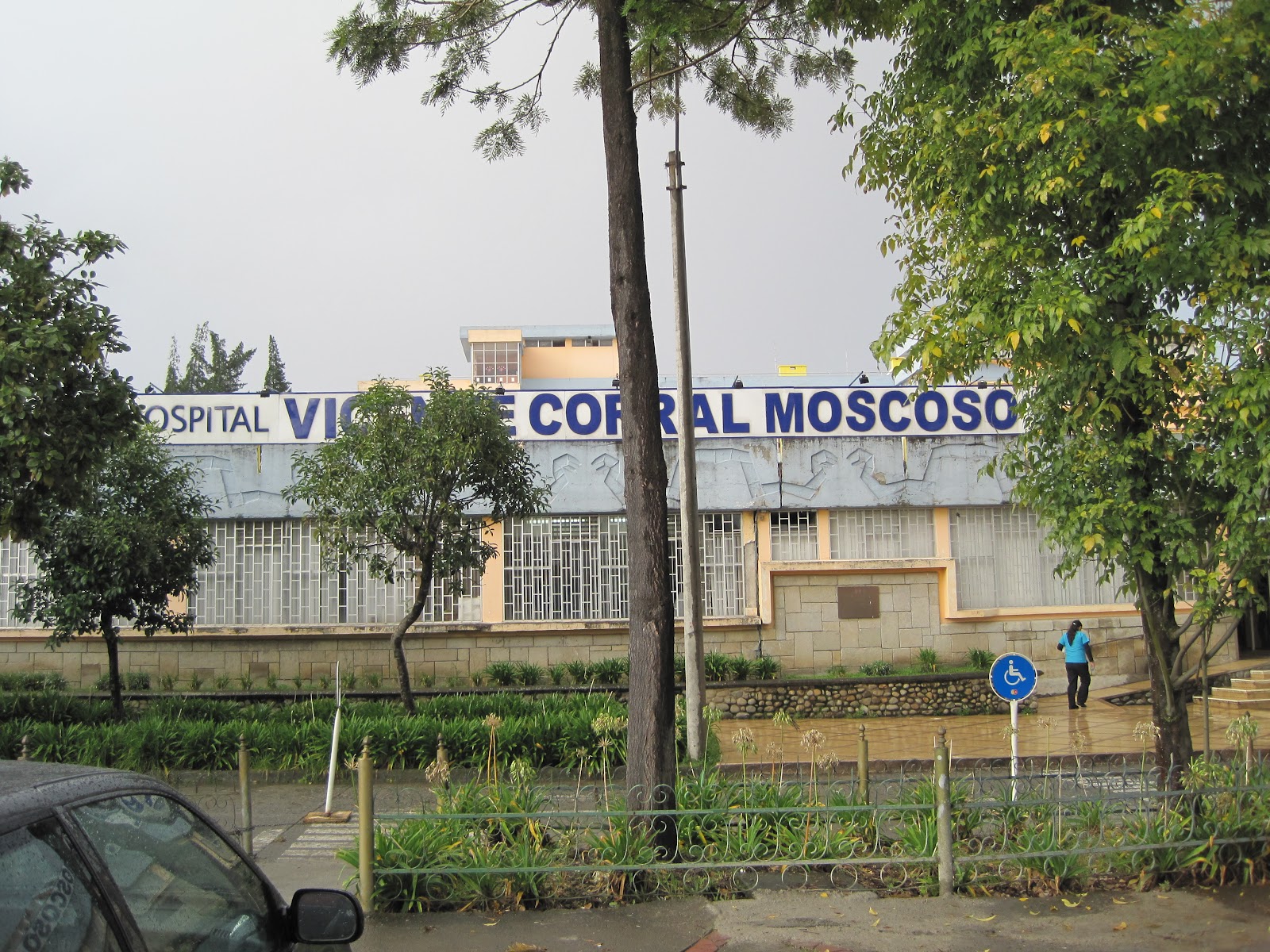
The next problem was finding the public hospital. We were told it was the hospital of Vergel as well as its general vicinity. We took the bus to the right area and started looking for the "Hospital de Vergel" with no luck. At that point, we started asking people. Eventually we were directed to the correct building which had a long name, none of which included the word Vergel. It turns out that Vergel is the name of the part of the city where the hospital is located.
| Emergency room |
Once inside the building, we were overwhelmed by the sheer size and chaos of the place. Seriously, a person could do their running practice in this building on those really rainy days. If you ran down every hallway it would surely add up to a few miles. There were crowds of people everywhere waiting, waiting, for what we didn't know. We found an information desk and showed her the green finger. Ewww!! She explained the directions to get to Curacion. We took the necessary turns and found the right room. Unfortunately, the person there told us we would have to take the finger to the Emergency Room. We followed the directions she gave us (we thought) to a big open room with a crowd waiting and asked about getting the help we needed. The people there told us the finger issue was not serious enough to warrant a trip to the E.R. They told us we would need to go to our local public health clinic at Feria Libre, a huge open food market near our home.
At this point we were unsure how to proceed. I was discussing it with my son as we walked back toward the hospital entrance, noting that the people at the E.R. had told us to go to the local clinic. My son interrupted, "Um, mom, that was the Audiology Department." I turned around to look at the sign and, sure enough, it said "Audiologia".
| A REALLY long name. |
We returned to the Information Desk to ask how to find the clinic. ¿Que pasa? We explained. She said there IS no public clinic at Feria Libre. Then she took pity on us. She abandoned her post to walk us all the way back to Curacion, where she exchanged a few words with the same woman who had sent us away the first time. Ninety seconds later the woman from Curacion was directing my son to come with her and for me to wait outside on the bench. I did not hear any screams, but when my son returned the finger was bandaged, presumably no longer green as all the green seemed to be in his face. When we discussed it later, he said he was sure that at the PRIVATE clinic they would have used an anesthetic.
He sat on the bench with me for a while until the nausea went away. During that time the woman from Curacion reappeared and told us we would have to go to the E.R. to get some medicine to prevent a re-infection. She walked us through various hallways to point us in the right direction to find the E.R. explaining that she could not write a prescription. Everywhere we went people seemed surprised to see the extranjeros (Foreigners) in the public hospital.
There was a small crowd at the E.R. and two little reception areas connected to the waiting room. We asked the person working at the first one what to do and she said we needed to talk to the person in the other room. That person was not there and it occured to us that maybe a lot of the people there were also waiting for this person to return. Apparently the locals were paying attention because when someone came out of the E.R. area, one of them told him the extranjeros needed help. That man then approached us and took us to an office inside where we spoke to a doctor who wanted to see the prescription which we did not have. She wanted to know the story of the finger after which she took us into a big E.R. room where people sat smiling with bloody bandages, amazed to see the extranjeros there. A doctor who was clearly busy was very pleasant in writing a prescriiption for us and directed us to fill it at a pharmacy. I really didn't know if we would have gotten the medication for free if we had looked poorer, but we were very happy to have the finger on the mend and left to find a pharmacy.
![]() | |
| I think he´ll live. |
We were never once asked for any information on our finances or immigration status. Apparently their services are free for anyone who walks in. This is SO different from the health care system in the U. S.! We also have Canadian friends here whose doctor explained to them that medical professionals are required to work some number of hours each week at the public clinics or hospitals, indicating that the care is really just as good, albeit more chaotic, to get.
Upon reflection, we felt very well cared for at the public hospital, having had so many people go out of their way to help us. And it was yet another of many cultural experiences, something we are not likely to stop having anytime soon!
Subscribe to:
Posts (Atom)